
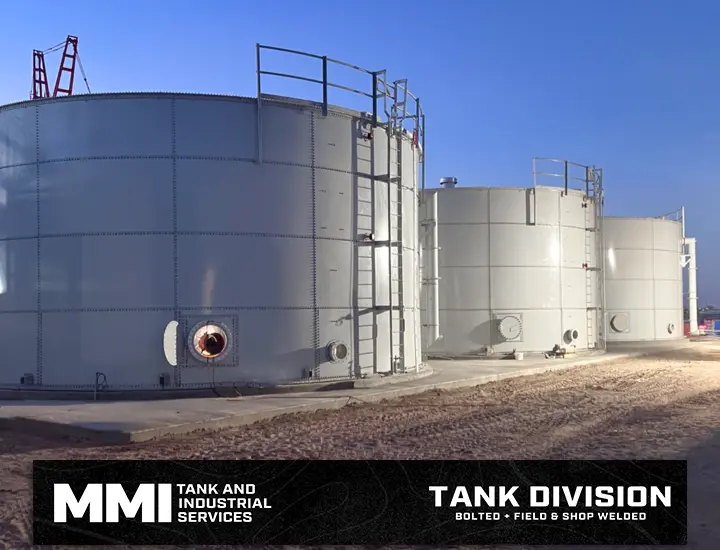
How much water do you need for fire protection? The answer depends on your facility type, hazard classification, fire suppression system design, and the requirements of your authority having jurisdiction (AHJ). But the math is straightforward once you have the inputs — and getting the tank size right is critical because an undersized fire water tank fails the one time it matters.
This guide walks through how fire water storage is calculated, what NFPA 22 requires, and how to choose between bolted and welded tank construction for your fire protection application.
The Basic Formula
Fire water tank capacity is calculated as:
Required storage (gallons) = Flow rate (GPM) × Duration (minutes)
Your fire protection engineer determines the flow rate based on the sprinkler system hydraulic design. The required duration comes from the applicable NFPA standard, FM Global data sheet, or AHJ requirement.
Typical Fire Flow Requirements by Facility Type
| Facility Type | Typical Flow Rate | Typical Duration | Minimum Storage |
|---|---|---|---|
| Light hazard (offices, churches, schools) | 500–750 GPM | 30–60 min | 15,000–45,000 gal |
| Ordinary hazard Group 1 (parking garages, bakeries) | 750–1,000 GPM | 60 min | 45,000–60,000 gal |
| Ordinary hazard Group 2 (retail, manufacturing, repair garages) | 1,000–1,500 GPM | 60–90 min | 60,000–135,000 gal |
| Extra hazard Group 1 (aircraft hangars, sawmills) | 1,500–2,000 GPM | 90–120 min | 135,000–240,000 gal |
| Extra hazard Group 2 (flammable liquids, plastics) | 2,000–2,500+ GPM | 120 min | 240,000–300,000+ gal |
| High-piled storage / distribution centers | 2,000–3,000+ GPM | 120 min | 240,000–360,000+ gal |
Important: These are general ranges from NFPA 13 (sprinkler design) and typical AHJ requirements. Your actual flow rate and duration must be determined by a licensed fire protection engineer based on the specific hazard analysis. Do not use this table as a substitute for engineering.
What Adds to the Storage Requirement
The basic sprinkler demand is often just the starting point. Additional factors that increase required storage include:
- Hose stream demand: NFPA 13 requires an additional 250–500 GPM for fire department hose streams on top of the sprinkler demand
- Multiple systems: Facilities with both sprinklers and foam systems, standpipe systems, or deluge systems must size for the combined demand
- Unreliable municipal supply: If the local water utility cannot guarantee the required fire flow, the tank must store 100% of the demand
- FM Global / insurance requirements: FM Data Sheets often require larger storage volumes than the building code minimum
- AHJ requirements: Local fire marshals may require storage durations beyond NFPA minimums based on response time and mutual aid availability
- Future expansion: Smart owners size for planned facility expansion to avoid a second tank later
NFPA 22 Tank Requirements
NFPA 22 (Standard for Water Tanks for Private Fire Protection) governs the tank itself. Key requirements:
- Construction per AWWA D100 (welded) or AWWA D103 (bolted)
- Foundation design for full-tank seismic and wind loads per ASCE 7
- Suction piping sized to prevent vortex and cavitation at the fire pump
- Overflow sized to handle the maximum fill rate
- Atmospheric venting with insect screens
- Freeze protection where minimum ambient temperature drops below 40°F
- Annual exterior inspection; five-year interior inspection
Bolted vs. Welded for Fire Water Tanks
For most fire water tanks under 500,000 gallons, bolted steel construction is the preferred choice because:
- Speed: Bolted tanks erect in 2–4 weeks — critical when compliance is on a deadline (new construction CO, insurance mandate, code violation)
- Coating quality: Factory-baked NSF/ANSI 61 coatings protect every surface including edges and bolt holes — no field-applied weak spots
- Remote sites: Panels ship flat on standard trailers to sites where mobilizing welding crews would be impractical
For larger capacities or when the fire tank is part of a larger field-welded tank farm, welded construction may be more practical.
Freeze Protection
Freezing is the most common cause of fire water tank failure. NFPA 22 requires freeze protection wherever minimum ambient temperatures drop below 40°F. Options include:
- Water circulation systems — prevent ice by keeping water moving
- Immersion heaters — electric or steam heaters maintain water above freezing
- Insulated shells — reduces heat loss in moderate cold; combined with heating in extreme cold
MMI designs and installs freeze protection as part of the tank scope — not as an afterthought.
Fire Water Tank FAQ
How do I calculate fire water storage for my facility?
Multiply your sprinkler system flow rate (GPM) by the required supply duration (minutes), then add hose stream demand. A fire protection engineer performs this calculation based on your specific facility and hazard classification.
What if municipal water pressure is unreliable?
If the local water supply cannot reliably deliver the required fire flow and pressure, a dedicated on-site fire water tank with a fire pump eliminates the dependency. The tank stores 100% of the fire protection water supply.
How fast can a fire water tank be installed?
A bolted fire water tank in the 15,000–200,000 gallon range can be erected in 2–4 weeks after panel delivery. Add 2–4 weeks for foundation. MMI can often begin fabrication immediately from stock panel inventory for common sizes.
Does MMI provide fire pumps and piping?
MMI provides the tank, foundation, suction piping, and fire pump connections. Fire pumps and controllers are typically supplied by the fire protection contractor. Our piping team handles the interface.
What coating is used inside a fire water tank?
NSF/ANSI 61-certified coatings — the same standard as potable water. Glass-fused-to-steel (bolted) or field-applied epoxy (welded). See our coating selection guide for details.
Next Steps
Have a fire water tank project? Tell us your flow rate, duration, and site location — or just tell us the facility type and we’ll help your fire protection engineer determine the requirement.
📞 (602) 272-6000 · 📧 info@mmitank.com · Request a quote online →

